Everyone Says "Write More Content." Everyone Else Says "Content Is Dead." Both Are Wrong.
What you'll learn
- Prioritize your content efforts using the correct hierarchy: GBP first, service pages second, blog content third.
- Write one niche-specific blog post per month using the question-heading + direct-answer format.
- Maintain all digital assets using the 3-6-12 Rule — a 2-3 hour monthly routine organized by frequency.
- Evaluate any SEO spending decision against a clear framework: what costs $0, what is worth $200-$500, and what is never worth paying for.
- Use AI tools ethically with proper clinical safeguards, including PHI protection and informed consent disclosure.
Too busy to read? View the 90-Second Version
Stop blogging weekly. Start a sustainable 2-3 hour monthly routine. The "publish constantly" era is over.
- Priority 1: GBP — A weekly 3-minute check: respond to reviews, update availability. Letting it go cold makes you look closed to the crawlers.
- Priority 2: Service pages — Refine one service page per month. Add FAQ sections, update language, improve specificity.
- Priority 3: Blog (maybe) — One highly specific, client-focused post per month maximum. "EMDR for first responders in Austin" beats "What is therapy?"
Quality and relevance completely outweigh quantity. One excellent post per month will outperform four mediocre ones — and cost you far less time.
Two Things Everyone Gets Wrong About Content in 2026
Someone on Instagram told you to write 52 blog posts a year. One per week. "Feed the algorithm," they said. Here is what actually happened to the therapists who followed that advice: they wrote 52 mediocre, generic articles about "Managing Stress During the Holidays," none of them ever ranked for anything, and they are now too burnt out to write the single, niche-specific page that would have actually moved the needle and brought clients through the door.
Then there is the opposite camp. "Content is dead. AI answers everything now. Why would I write anything at all?"
"Content strategy in 2026 is not about volume. It is about format and specificity. You do not need a library of 100 blog posts. You need a handful of genuinely useful, niche-specific pages."
Both positions are wrong. And the reason both feel true is that most content advice is written by people selling services. The agencies telling you to "write more" are the ones charging you by the blog post. The ones saying "content is dead" are trying to sell you "AI optimization" retainers. Neither has an incentive to tell you the simple clinical truth.
You need to format your pages so that both human beings in distress and AI systems searching for sources can instantly extract value. Then you need a simple, low-stress routine that keeps everything maintained so your authority compounds instead of decaying over time. It's that simple.
The Content Hierarchy
Most therapists spend 90% of their marketing energy on the thing that matters third and 10% on the thing that matters first. It is like spending three hours choosing the perfect throw pillows for your physical office and then forgetting to unlock the front door so clients can actually walk in.
Here is the correct priority order you must follow:
Priority #1: Your Google Business Profile
Your GBP is the single highest-impact, lowest-effort marketing asset you own. It is free and takes minutes to maintain. Keeping reviews answered and your info accurate supports prominence and trust. Long-term neglect risks a stale profile — or even suspension of a long-dormant listing.
Priority #2: Your Service Pages
Built in Module 3, these describe your clinical specialties. In 2026, they require 20 minutes of formatting adjustments: question headings and direct answers. (FAQ schema is optional and no longer produces FAQ rich results.) Do not rewrite them from scratch — simply structure them so AI Overviews can parse them for instant citations.
Priority #3: Blog Content
This is third. Not first. Third. And only if it answers a highly specific, emotionally resonant question that your ideal client archetype is actively typing into the search bar late at night. General informational fluff gets swallowed by AI answers instantly; niche depth thrives.
What to Write and What to Stop Writing
Stop writing "5 Tips for Managing Anxiety." AI already answers that question better and faster than any therapist's blog ever will. Generic informational listicles are the exact category most aggressively cannibalized by Google's AI Overview summaries.
Start writing pages that answer specific, emotionally rich questions that your ideal client is actually struggling with right now. Let's look at the difference:
Generic (Stop Writing This)
"5 Tips for Managing Anxiety"
AI summarizes this instantly at the top of search pages. You cannot compete with high-volume, generic definitions. It is a waste of your clinical energy.
Niche (Write This Instead)
"Is It Selfish to Go to Therapy When My Kids Need Me More?"
Deeply emotional, specific questions your archetypes ask. AI will cite you because it lacks authentic human clinical context to write this answer.
The second question is sitting in the search bar of every Parentified Child archetype in your city right now. They are not searching for tips. They are searching for permission. And AI Overviews will cite the therapist who answers it directly — because it is specific, it is empathetic, and it demonstrates genuine clinical expertise that AI cannot fabricate.
Here are three high-performing examples mapped directly to our core client archetypes:
For the Burnt-Out Gifted Kid
"Why Does Therapy Feel Like Another Thing on My To-Do List?"
Validates high-achievers who treat therapy as another system to optimize rather than a space to let go and rest.
For the Marginalized Survivor
"How Do I Know If a Therapist Is Actually Affirming — Not Just Performatively?"
Speaks directly to safety, credentials, and systemic understanding for neurodivergent or LGBTQIA+ clients.
For the Parentified Child
"I've Always Been the Strong One. When Do I Get to Fall Apart?"
Validates the exhausting burden of family caretaking roles and sets the boundary for their own healing.
Each of these becomes a page with question headings, direct answers, FAQ schema, and genuine clinical depth. One per month is sustainable. One per month is all it takes to build a highly optimized, authority-compounding asset library.
The Monthly Routine
This is the most important section in the entire course. Everything you have built across six modules — GBP, website, directories, referral network, AI-formatted content — needs maintenance. Without it, your SEO does not compound. It decays. The total time investment: 2-3 hours per month. That is less time than most therapists spend per week worrying about their marketing.
Search Console + Analytics
- Analyze top queries: Review which organic keywords and specialty queries are bringing actual traffic to your site.
- Monitor index state: Look for crawl errors or index warnings. If Google cannot index a page, AI cannot cite it.
- Check conversions: Measure how many people clicked your contact link or called your number this month.
GBP Care & Reviews
- Address & Hours: Maintain strict accuracy. Inconsistent listings genuinely confuse Google's entity matching — it can cost you visibility.
- HIPAA Review Responses: Respond immediately to any reviews using the safe templates from Module 2.
- Fresh Visual Assets: Upload 1-2 real photos of your office, waiting area, or entrance doors to your profile.
Content & NAP (Name, Address, Phone) Refresh
- Update old content: Pick one old page, update its metadata, and add fresh internal links.
- Directory NAP (Name, Address, Phone) Audit: Verify that your name, address format, and phone number on psychology directories match your website perfectly.
- Draft new post: Write your single monthly niche post using the question-heading framework.
You do not have to do all three hours at once. Split it: 15 minutes on Monday (GBP check), 30 minutes on Thursday (content refresh), the rest on a Saturday morning with coffee. It fits around sessions. It fits around life.
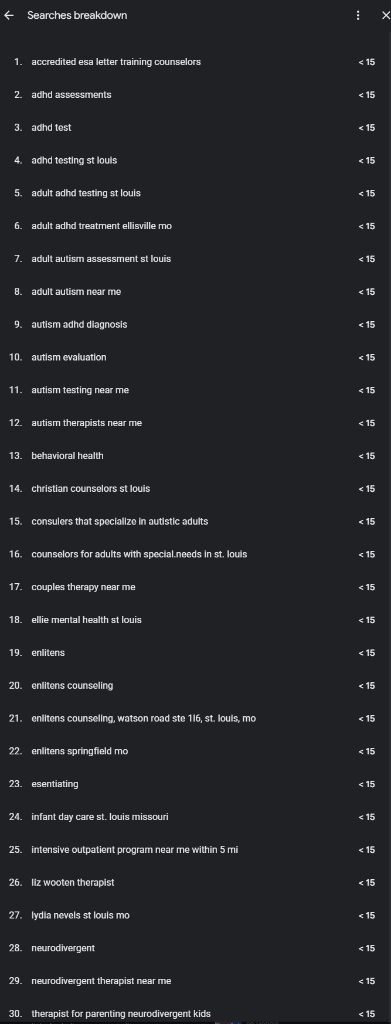
Audit this searches breakdown during Hour 1 of your monthly routine. If niche terms like 'ADHD therapist' or 'autism assessment near me' are appearing with traffic, your local profile optimization is working. If you only see your own name, you need to enrich your profile content and service pages with more descriptive niche keywords.
The 3-6-12 Rule
If you started implementing everything from Modules 1-6 today, here is what realistic progress looks like. Anyone promising results faster than this is selling a grift.
Foundation Building
Your GBP is optimized. Your service pages are reformatted with schema. Your first referral outreach emails are sent. You will see very little measurable change in client inquiries yet. That is normal. You are pouring concrete, not styling the roof.
Early Signals
Your search engine rankings begin shifting. You start appearing on Page 1-2 for niche terms. Your GBP starts generating more direction requests and direct phone calls. A client mentions they found you through Google for the first time. Compound interest has begun.
Compounding ROI
Consistent organic traffic — people finding your website through regular Google searches, not paid ads. Regular caseload inquiries. Your cost per acquisition — what each new client costs you to acquire — decreases to near-zero as your organic authority matures. The referral network from Module 5 runs on its own momentum. Your monthly routine keeps it running in 2 hours a month.
SEO is a compounding financial investment, not a slot machine. Google's own guidance says SEO changes generally take "four months to a year" to show results (Do You Need an SEO?, Google Search Central). Legitimate progress requires patience, but once the momentum shifts, it is incredibly difficult for competitors to displace you.
What to Pay For and What to Never Pay For
Here is your spending decision framework. Refer to it every time an agency pitches you a "revolutionary" new marketing service.
Do It Yourself
- GBP setup and weekly checks
- Basic schema plugin setup
- Question heading formatting
- Referral pipeline outreach
- Your monthly routine
One-Time Audit
Pay a legitimate technician or developer for a professional, one-time technical audit. Let them scan for crawl errors, slow page speeds, mobile rendering issues, and schema breaks. Fix them, pay once, and walk away.
Legitimate Local SEO
Only if you genuinely have a high caseload and zero time or interest to DIY. Hire an agency that itemizes their monthly deliverables, provides clear traffic-to-caseload reporting, and has no locked contracts.
AI SEO Grifts
- Monthly "AI SEO" retainers ($1.5k+)
- "Guaranteed AI citations" (impossible)
- AI content blasts (violates spam policy)
- AEO/GEO as a separate line item
- Proprietary "AI-powered" audits
A personal safety valve: If you ever have a marketing proposal or contract sitting in front of you and you are not sure whether it's legitimate, email it to me. liz@enlitens.com. Free, no pitches, no contracts. Just a colleague willing to check the numbers and tell you if it's a scam.
Using AI Tools Without Losing Your License
AI tools are useful administrative assistants. They are not clinical replacements, and using them comes with real ethical obligations to your clients and state licensing board.
If you want to use AI assistance for clinical documentation — such as progress notes or intake summaries — use only tools that provide a verified HIPAA Business Associate Agreement. Tools like Upheal and Mentalyc are built specifically for clinical environments. Verify the BAA yourself before entering client data. If they cannot produce one, do not use the tool.
Your Monthly Maintenance Checklist
Download the Monthly Maintenance Routine checklist. It organizes everything we have learned into a clean, repeatable system that runs in the background of your practice.
You now have the complete system. Your GBP is solid, your website service pages are formatted for AI citation, your directory profiles are consistent, your referral network is healthy, and your monthly routine keeps it all compounding. There is only one thing left, and it is the thing most courses skip because it is not marketable as a course topic.
How to protect yourself from the predatory agencies that will try to take all of this away from you. Let's move to Module 7.
No jargon left behind. You are not supposed to know these terms yet. Here is the plain-English decoder for every piece of digital vocabulary used in this lesson, along with its real impact on your practice.
- GSC (Google Search Console)
-
A free diagnostic dashboard Google provides to track which exact search queries bring visitors to your site and monitor indexing health.
SEO Practice Insight:GSC is the ultimate authority on whether your SEO is working. It shows the real search terms local clients type, allowing you to refine your content.
- Crawl Indexing (Crawl State)
-
When Google's automated scanning software successfully reads your website files and officially catalogs them in Google's search index.
SEO Practice Insight:If a page has crawl errors, it is invisible to search engines and AI models alike. Monitoring your indexing state ensures your content is live.
- NAP (Name, Address, Phone)
-
The crucial business directory information (Name, Address, Phone number) that must match identically across every profile on the internet.
SEO Practice Insight:Minor variations (like writing "Suite 102" on your website but "Ste 102" on GBP) confuse search crawlers and lower your local prominence ranking.
Key takeaways
- GBP is priority #1 — not your blog. Service pages are #2. Blog content is #3, and only if it answers specific questions your client archetype actually asks.
- Write niche, not volume. "Is It Selfish to Go to Therapy When My Kids Need Me More?" outperforms "5 Tips for Managing Anxiety" in both human engagement and AI citation potential.
- The monthly routine is 2-3 hours. Hour 1: Search Console. Hour 2: GBP + reviews. Hour 3: Content refresh. Split it across the week.
- Know what to pay for. $0 for everything in this course. $200-$500 for a one-time technical audit. Never pay for monthly "AI SEO" retainers or guaranteed AI placements.