You Probably Got an Email About "AI Search Optimization." Here Is Why Every Claim in It Was Wrong.
What you'll learn
- Explain how AI search actually works (it pulls from the same Google index, not a separate catalog) and why there is no secret AI database.
- Identify why your existing Modules 1–5 foundation (GBP, service pages, referral network) is more valuable in the AI era, not less.
- Apply two formatting adjustments — question headings and FAQ sections — that make your existing content AI-citation-eligible.
- Recognize the 8 red-flag sales tactics used by agencies selling "AEO" and "GEO" as separate services.
- Cite Google's own documentation (May 15, 2026) confirming that AEO and GEO are "thus still SEO."
Too busy to read? View the 90-Second Version
AEO and GEO are just new buzzwords for solid SEO. Google has explicitly said this — optimizing for AI means optimizing for users.
- AEO (Answer Engine Optimization) — Structure your content to answer specific questions clearly. FAQ sections, direct answers in the first paragraph.
- GEO (Generative Engine Optimization) — Write authoritative, well-cited content that AI systems want to quote. This is just good writing.
- The $3K/month grift — Agencies selling "AI Search Optimization" as a separate service are repackaging what you're already learning in this course.
If your foundational SEO is solid (Modules 1-5), you are already optimized for AI search. There is nothing extra to buy.
You Probably Got an Email Like This
Here is an email that landed in my inbox last month. Yours probably looked similar.
"Dear Dr. Wooten, I noticed your practice doesn't appear in AI search results. Your competitors are already optimizing for Answer Engine Optimization (AEO) and Generative Engine Optimization (GEO). If you don't act now, you risk losing visibility entirely. Our proprietary AI optimization framework has helped hundreds of practices increase their AI citations by 300%. Let's schedule a call to discuss your AI search strategy."
Let's count the red flags.
- "Dear Dr. Wooten" — I am not a doctor. I am an LPC. They did not even check my credential before hitting send. When the pitch starts with the wrong title, you know they sent this to a list, not a person.
- "Your practice doesn't appear in AI search results" — false. There is no separate AI search catalog. AI pulls from the same Google index your website is already in.
- "Your competitors are already optimizing" — vague. Which competitors? Optimizing what, specifically? No names, no evidence, no data.
- "Our proprietary framework" — proprietary means "we cannot explain it to you, but please pay for it."
- "Increase AI citations by 300%" — a meaningless number tied to an undefined metric that no one, including Google, can guarantee.
This email has more red flags than a Soviet parade.
I want to be honest with you. When AI Overviews started appearing on every search result page, I had a moment of genuine panic. I had spent months helping therapists build their online presence, and suddenly the internet was telling me all of it was obsolete. It took me three weeks of reading Google's actual documentation — not Instagram hot takes — to realize it was not. Your foundation is solid. The game did not change. The scoreboard did.
What Actually Changed
Here is what is real.
Google now shows AI-generated summary boxes — called AI Overviews — at the top of many search results. By some measures they now appear on ~89% of health-related searches (BrightEdge, Dec 2025) — estimates vary by study — and they have had a massive impact on click-through rates. Here are the baseline metrics you need to know:
That sounds terrifying. Now the part that undercuts the "AI search optimization" sales pitch.
As of mid-2026, AI Overviews rarely appear on local service searches. "Therapist near me" — still routes to the Map Pack. "Counselor in St. Louis" — Map Pack. "Anxiety therapist accepting new clients" — Map Pack. The searches where someone is actually trying to book a therapy appointment are the ones where local intent still wins. That could change; the fundamentals don't.
The queries that trigger AI Overviews are informational: "what is EMDR therapy," "signs of depression in teenagers," "difference between CBT and DBT." These are questions that AI can summarize. They are not the queries that fill your caseload. The queries that fill your caseload — local, high-intent, "find me a therapist" — still run through the traditional Local Map Pack, the same GBP you built in Module 2.
And here is the counter-dynamic that actually matters: brands and websites that get cited within the AI Overview see substantially more organic clicks than uncited competitors — roughly 35% higher organic CTR (91% higher for paid ads), per Seer Interactive. Being cited by AI is not a threat — it is a multiplier. The question is not "how do I survive AI." The question is "how do I get cited by it."
The answer, it turns out, is something you have mostly already done.
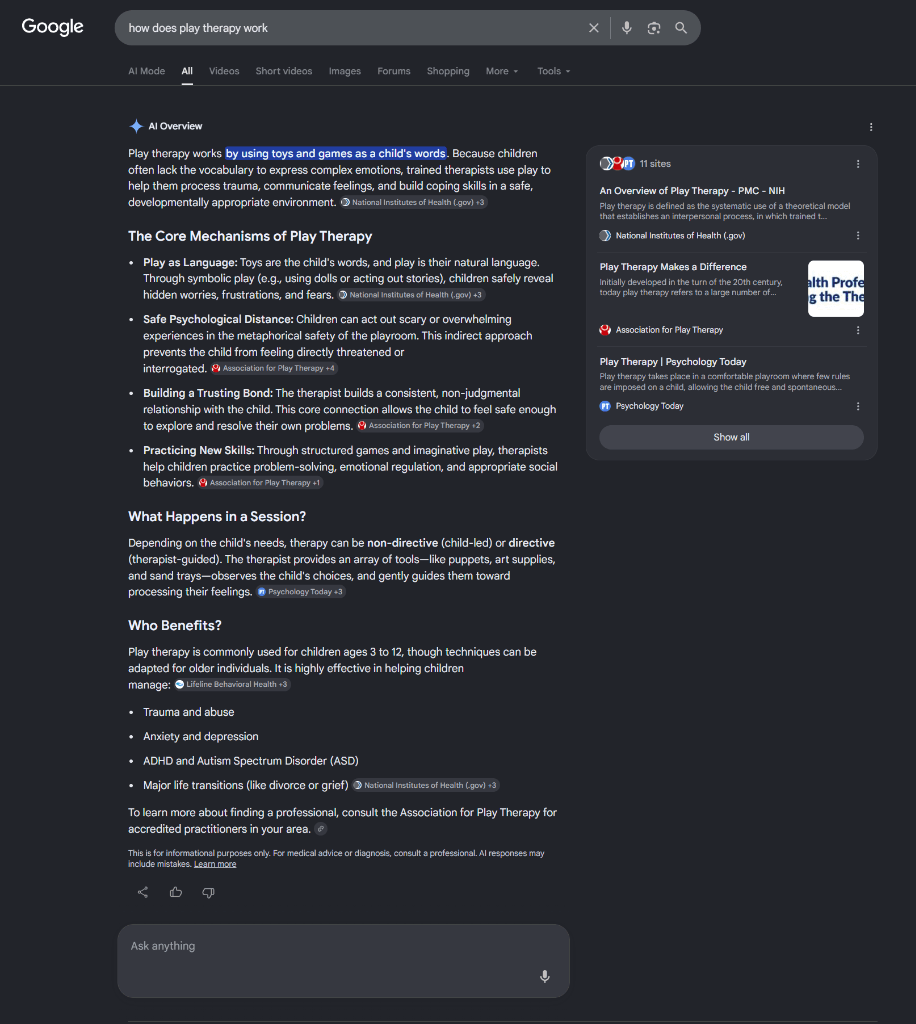
As of mid-2026, AI Overviews rarely appear on local service searches like 'therapist near me' — local intent still routes to the Map Pack. The queries that trigger these boxes are informational — 'what is EMDR therapy' — which means your blog content is what gets cited here, not your service pages.
How AI Search Really Works
AI search is not a separate system. It is the same system wearing a different hat.
When someone asks Google a question and an AI Overview appears, the AI does not make up an answer from memory. It uses a process called retrieval-augmented generation — which is a technical way of saying it searches Google's existing index of websites, finds the most relevant and authoritative sources, and writes a summary based on what it found.
Same index. Same ranking signals. Same quality standards. Your website is already in the catalog AI pulls from.
When the question is complex, the AI breaks it into several smaller sub-questions and searches the index separately for each one. More searches of the same catalog — not a different catalog.
This is why the premise behind most "AI SEO" pitches is fundamentally flawed. There is no secret AI catalog you need to pay someone to get you into. If your website ranks in regular Google search, AI can already find it and cite it. One caveat: that is true for Google — ChatGPT search leans on Bing's index and Perplexity crawls the web independently, so make sure your site is indexed in Bing (free, via Bing Webmaster Tools) and that your robots.txt isn't blocking GPTBot or PerplexityBot. The only remaining question is whether your content is formatted in a way that makes it easy for AI to extract and summarize.
What You Already Have
Let me map what you have built across Modules 1–5 directly to what AI systems look for when deciding what to cite:
Module 2 — Google Business Profile
Your GBP is already structured data. Every field you filled in — your name, address, specialties, hours, categories — is machine-readable information that AI systems use to verify your identity and location. You were already optimizing for AI without knowing it.
Module 3 — Your Website
Your service pages, written with genuine clinical expertise and empathy, already satisfy Google’s quality checklist — they call it E-E-A-T (Experience, Expertise, Authoritativeness, Trustworthiness). AI systems rely on these signals even more heavily than traditional search.
Module 4 — Directories
Your optimized Psychology Today profile, your TherapyDen listing, your consistent NAP (name, address, phone) across directories — these create entity consistency. AI systems cross-reference multiple sources to verify that you are a real provider.
Module 5 — Referral Network
Your PCP referral pipeline is completely algorithm-proof. No AI system, no algorithm update, no search engine change can disrupt a direct physician-to-therapist referral relationship. This is the 39% of discovery that runs on trust, not technology.
You are not starting from zero. You are most of the way there. What remains is two formatting adjustments.
The Two Things You Need to Add
Here is the genuinely new work. It takes about 20 minutes per page.
That is it. Question headings with direct answers, and an FAQ section. Twenty minutes per page. Zero new content required — just reformatting what you already have.
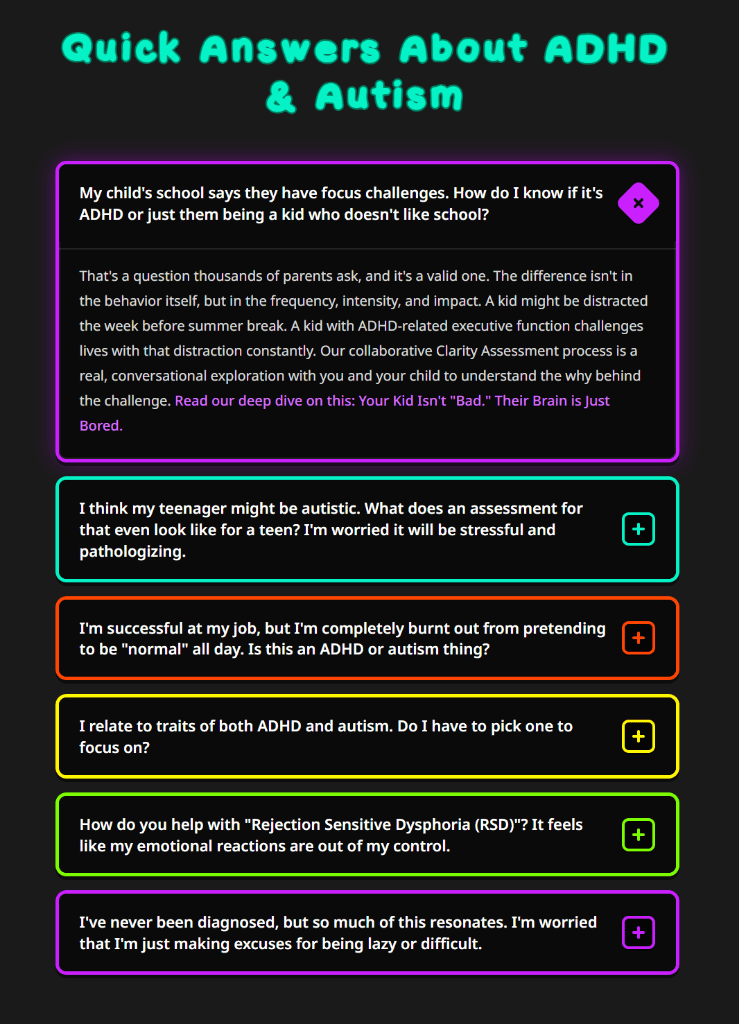
Aim for under 60 words per FAQ answer — a practical rule of thumb, not a Google spec. Longer answers tend to get truncated; shorter answers lack enough context to cite.
What Google Actually Says About AEO and GEO
This is the part where I get to use Google's own words. It is extremely satisfying.
On May 15, 2026, Google published a page on their Search Central documentation titled "Optimizing for generative AI search." And they filed it under "SEO fundamentals." Not "AI strategy." Not "Advanced AEO." Not a separate category. The same section where they explain what a meta tag is.
"From Google Search's perspective, optimizing for generative AI search is optimizing for the search experience, and thus still SEO."
Thus. Still. SEO.
The marketing industry has developed an impressive ability to rename things that already exist. SEO became AEO became GEO became SGE became LLMO — honestly, I lost track. It is like watching someone rebrand "walking" as "Autonomous Bipedal Locomotion" and then charging you $1,500 a month to do it.
On the same documentation page, Google published a mythbusting section. They specifically say you do NOT need:
- LLMS.txt files — not necessary for AI discovery
- Content chunking for AI — does not help
- AI-rewritten content — no advantage over well-written human content
- Fake brand mentions — does not improve AI visibility
- AI-specific structured data — does not exist. Standard schema is sufficient.
If you have ever been pitched any of these by an agency, I need you to pull up that proposal and count how many of these five items they included as line items. That is your refund calculation.
How to Spot the Pitch: 8 Red Flags
Here are the 8 red-flag sales tactics I have documented from actual agency pitches targeting therapists. I am not naming anyone. I am naming patterns.
They flood the pitch with AEO, GEO, AIO, LLMO, SGE to overwhelm you. If you cannot define every term they use, you feel like you need an expert. That is the point.
"If you don't optimize for AI now, you'll disappear by Q3." Which competitors? Disappear from what? They never specify because the threat is manufactured.
"Our proprietary AI optimization framework discovers hidden opportunities." Google published the entire playbook for free. There is no secret.
"We'll get you recommended by ChatGPT." No one can guarantee AI recommendations. Google themselves say: "No one can guarantee a #1 ranking on Google." If that applies to regular search, it absolutely applies to AI answers.
"We'll generate hundreds of blog posts to train AI engines." This directly violates Google's scaled content abuse policy from March 2024. It can get your entire website removed from search results.
Your invoice shows "SEO: $1,500/mo" and "AEO/GEO: $2,000/mo" as two separate charges. Google says they are the same work. You are being double-billed.
They sell "LLMS.txt implementation," "content chunking," and "AI-specific schema" — all things Google specifically says do not work.
Google's own "Do you need an SEO?" page specifically warns against firms that email you out of the blue. They compare it to diet pill spam.
Your Anti-Grift Defense Script: If someone asks you to pay for AEO or GEO services, here is your script: "Can you list every deliverable that is different from standard SEO? And can you explain why Google says AEO and GEO are — and I'm quoting — 'thus still SEO'?" If they can answer that coherently, I would genuinely love to see the response. Forward it to liz@enlitens.com. I collect them.
Your 20-Minute Action Plan
Pick your best service page. The one that describes your core specialty most clearly, and complete the checklist below:
Total time: 20 minutes. You have now done 80% of what agencies charge $3,000/month for. The other 20% is a monthly routine — and that is what we'll tackle in Lesson 6.2.
No jargon left behind. You are not supposed to know these terms yet. Here is the plain-English decoder for every piece of digital vocabulary used in this lesson, along with its real impact on your practice.
- AEO & GEO (Answer/Generative Engine Optimization)
-
Structuring your website text so conversational AI models (like Google's AI Overview or ChatGPT) can easily read, parse, and cite your page.
SEO Practice Insight:AEO and GEO are mostly SEO fundamentals repackaged — be skeptical of anyone selling them as an entirely separate, premium service, though they do add some new AI-citation tactics. AI engines don't guess; they look for direct answers to specific clinical questions and link to them.
- FAQ Schema Markup
-
An invisible digital label added to your question-and-answer text that explicitly tells Google: "This is a structured Q&A segment."
SEO Practice Insight:Don't expect a fancy dropdown in search results — Google removed FAQ rich snippets for everyone — only government/health sites kept them after 2023, and even those were dropped in 2026 — so a private practice won't get that treatment. The real benefit: question-formatted content is exactly what AI Overviews extract and cite, with or without the markup.
- RAG (Retrieval-Augmented Generation)
-
The process AI search engines use to scan and pull factual data from trusted external websites before writing out a conversational answer.
SEO Practice Insight:RAG is why local content is still king. If your page provides the most specific, clear clinical answer, the AI engine retrieves it and cites your link.
- Query Fan-out
-
When an AI system takes a searcher's conversational question and automatically generates multiple variations to find the absolute best matches.
SEO Practice Insight:Because AI fans out queries, having a page that addresses both technical terms and emotional synonyms increases your search matching footprint.
Key takeaways
- AI search runs on the same Google index as regular search. There is no separate AI catalog. If you rank in regular search, AI can already find you.
- As of mid-2026, AI Overviews rarely appear on local service searches like "therapist near me" — local intent still routes to the Map Pack. That could change; the fundamentals don't.
- Your Modules 1–5 foundation (GBP, service pages, directories, referral network) is more valuable in the AI era, not less. You are most of the way to AI citation eligibility.
- Google confirmed on May 15, 2026 that AEO and GEO are "thus still SEO" — not a separate discipline, not a separate service.