AI Overviews and What They Mean for Your Practice
What you'll learn
- Explain what AI Overviews are in plain language
- Understand why they affect some searches more than others
- Recognize that the actions from Lessons 1-2 also help your AI visibility
- Spot the warning signs of an "AI SEO" sales pitch
Too busy to read? View the 90-Second Version
AI Overviews mostly affect informational searches, not local ones. The searches that get you clients are the least impacted.
- Informational queries ("what is EMDR") — AI Overviews appear frequently. Low client intent anyway.
- Local service queries ("therapist near me") — AI Overviews rarely appear. These are your money searches.
- High-intent queries ("EMDR therapist Austin accepting Aetna") — Almost never get an AI Overview.
If an agency pitches you an "AI Search Optimization" package, they are repackaging standard SEO with a new label. Focus on your foundational SEO — it is what AI pulls from anyway.
What AI Overviews Actually Are
If you've been hearing that AI is going to destroy everything and you need to completely redo your marketing strategy — take a breath. That's mostly marketing companies trying to sell you a new thing.
When you Google something now, you'll sometimes see a paragraph at the top of the results page that wasn't written by any website. It's written by Google's AI, pulling from multiple sources to give you a summary answer before you click on anything.
Google calls these "AI Overviews." Before that, people worried about "Featured Snippets." Before that, the "Knowledge Panel." The specific format keeps evolving. What it means for you stays pretty consistent.
Google has also rolled out AI Mode — a full chat-style search tab that launched in 2025 and kept expanding through 2026. It's the same story underneath: Google's AI summarizing from sources it trusts. The fundamentals in this course — a complete Google Business Profile and clear, human content — are what get you cited there too.
If someone searches "types of therapy for AuDHD burnout," Google's AI might generate a 3-4 sentence summary at the top explaining EFT, somatic experiencing, and nervous system regulation — pulling from medical sites, therapy directories, and sometimes therapist websites. The searcher gets their answer without clicking through.
That's an AI Overview. It's not magic. It's Google summarizing what your website (and others) already say.
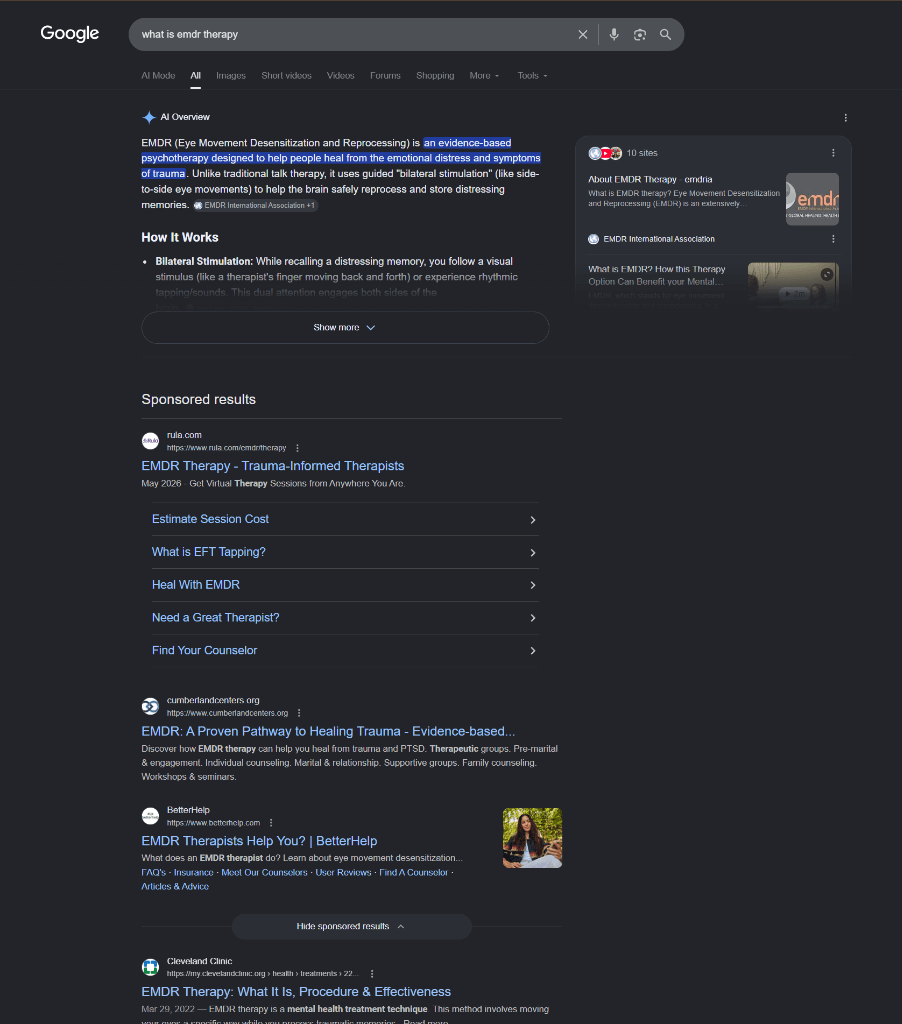
AI Overviews primarily show up on informational queries like 'what is EMDR.' They rarely appear on 'therapist near me' searches — which are the ones that actually get you clients. The next screenshot proves this.
The Numbers (And Why They're Less Scary Than Headlines)
Those numbers are real. But context matters.
Most affected
Informational searches — "what is EMDR," "types of anxiety disorders," "how does therapy work." Questions where Google can summarize a factual answer.
Least affected
Local, decision-stage searches — "AuDHD therapist near me," "therapist accepting new patients in Chicago," "play therapist reviews." These require clicking through to a real profile. Google's AI can't book a therapy appointment.
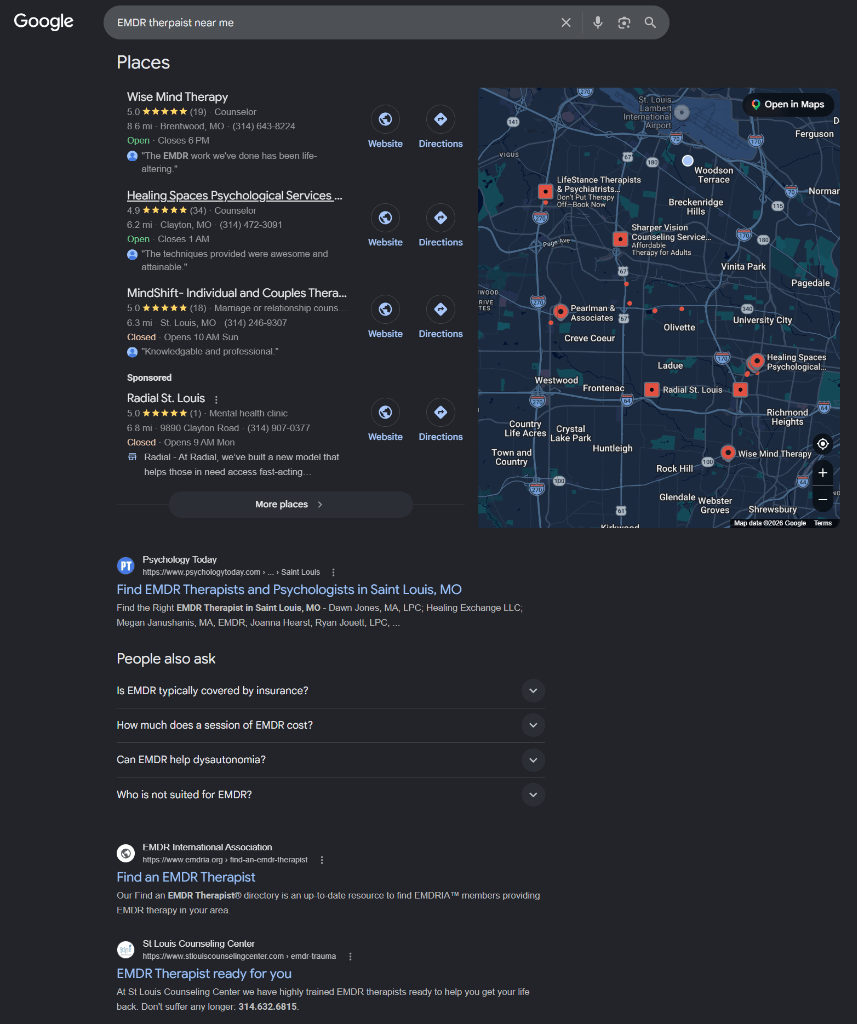
This is why we don't panic about AI Overviews. The searches where someone is ready to book a session — the ones with local intent — almost never trigger an AI summary. Google knows these searches need a specific, local human, not a generic paragraph.
How People Search Differently Now
People used to search in shorthand. "Anxiety therapist STL." Three words. Like a telegram.
Now, people type full sentences. "What kind of therapist helps with anxiety and panic attacks in St. Louis?" AI-driven queries commonly run 8-11 words or longer.
This is good news for therapists. You already know how to answer real questions from real people — that's what you do in sessions. If your website answers questions the way you'd answer them in a first session, your content is naturally optimized for 2026 search.
The Follow-Up Search (And Why It's an Opportunity)
Most people miss this: AI Overviews don't end the search. They change what comes next.
When someone reads an AI Overview, the search often doesn't end there. They ask a follow-up question. A deeper one. This is the same pattern you see in your office — a client asks a broad question, you explain it, and then they ask the real question underneath.
For your website, the most valuable content isn't the surface-level explainer. It's the follow-up. The secondary question. The "what happens next" and "how do I know if this is right for me." Answer those, and you become the resource the AI points people toward.
Why This Makes Everything You Just Learned More Important
AI Overviews don't change what you need to do. They make everything from Lessons 1 and 2 more important.
GBP matters more
AI Overviews pull from GBP data when generating local summaries. A complete, current profile is more likely to be cited.
Reviews matter more
Google's AI references review content and ratings for local AI Overviews. More recent reviews and thoughtful responses all feed the AI.
Clear content matters more
When your pages use plain, specific language, AI can extract and present it. Clinical abstractions get skipped because AI can't parse what you do.
Same actions. Bigger payoff. The work you'd do anyway for traditional SEO now serves double duty.
The "AI SEO" Sales Pitch Is Coming
If it hasn't happened already, someone will email you offering "AI-Optimized SEO" for your therapy practice. They'll use words like "machine learning integration," "algorithmic positioning," and "AI-first content strategy."
What they're actually selling is the same thing they were selling last year, with a new label.
If someone pitches you AI SEO services, ask them one question: "What specifically would you do differently than you would have done before AI Overviews existed?"
If the honest answer is "not much" — which it usually is — then what they're selling is regular SEO with an AI surcharge. Now you know.
What You've Learned in Module 1
You now understand three things most therapists don't:
You didn't need a four-figure course to learn this. Premium competitor courses often charge that much primarily to bundle 1-on-1 coaching or consults with the creator. But you don't need a paid coach to do this right. You can email us and we will give you direct advice — zero sales pitches, just free help.
Module 2 puts this into practice. You'll set up (or fix) your Google Business Profile in about 30 minutes — the single highest-impact action you can take.
You now understand what SEO actually is (and is not), how clients search in 2026, and why AI search does not change the game for local therapists. You have the conceptual foundation. Module 2 puts it into action — starting with your Google Business Profile.
No jargon left behind. You are not supposed to know these terms yet. Here is the plain-English decoder for every piece of digital vocabulary used in this lesson, along with its real impact on your practice.
- AI Overviews (formerly SGE)
-
The quick, conversational summary placed at the very top of Google search results that directly answers queries using conversational text.
SEO Practice Insight:AI overviews do not replace websites; they rely on them. By formatting your pages with question headings and FAQ sections, you make it easy for AI to cite you as the source.
- Citations (AI Citations)
-
The clickable reference links embedded directly inside an AI-generated answer that verify where the AI got its information.
SEO Practice Insight:Citations act as modern, digital referral pathways. When an AI search cites your page, it sends highly qualified, pre-educated clients directly to your site.
- Large Language Models (LLMs)
-
Sophisticated AI systems (such as ChatGPT, Claude, or Google Gemini) designed to read, summarize, and write conversational, human-like answers.
SEO Practice Insight:LLMs are excellent administrative helpers for outline drafting, but they lack the lived clinical empathy and context required to write genuine therapeutic copy.
Key takeaways
- AI Overviews are Google's AI summarizing search results. They affect informational searches more than local ones.
- The searches that get you clients are the least affected. "Therapist near me" still requires clicking through to real profiles.
- Everything from Lessons 1-2 still applies — and matters more. GBP, clear content, and reviews now serve both traditional search AND AI visibility.
- If someone sells you "AI SEO," ask what's actually different. Usually, the answer is "nothing."