The Profile Nobody Clicks: Rewriting Your PT Personal Statement
What you'll learn
- Identify why credential-first profile openings fail to convert searchers into clients.
- Describe the actual anatomy of Psychology Today’s personal statement: 3 text boxes (640 + 360 + 360 = 1,360 total characters), with a ~270-character preview snippet.
- Apply the 3-Box Funnel framework (Pain → Process → Invitation) to rewrite your profile from a professional résumé into a conversion tool.
- Narrow your specialty list from 15 broad categories to 3 specific clinical niches that outperform generalist profiles.
- Record a 25-second video intro that unlocks triple visibility: filter inclusion, visual differentiation, and trust signaling.
Too busy to read? View the 90-Second Version
Your Psychology Today profile is a conversion tool, not a résumé. Most therapist profiles read like grad school applications.
- 270 characters — That's all a potential client sees before the "Read More" button. If your first sentence is your degree, they've already scrolled past.
- The 3-Box Funnel — Your personal statement is three boxes: Pain (name their struggle), Process (what sessions feel like), Invitation (the specific first step). Each box has a specific job.
- Write to one person — "You" is the most powerful word in your profile. Speak directly to your ideal client's experience, not to a review board.
Start with the 15-Minute Rewrite: one sentence that names your ideal client's pain, in their words. That alone can immediately increase your inquiry rate from the directory.
The Profile Nobody Clicks
I am going to show you the first sentence of some therapist profiles on Psychology Today. You will recognize it immediately, because you have probably read it a hundred times. Or written it yourself.
“I am a Licensed Professional Counselor with 10+ years of experience specializing in anxiety, depression, and life transitions.”
If your profile opens with something like this — or with “I provide a warm, empathic, non-judgmental environment” — you are in the overwhelming majority. This is not a criticism. When you spend years fighting for licensure and learning clinical frameworks, leading with your credentials feels natural. It is what you trust. It is what your supervisors taught you to value.
The person reading your profile at 2 AM does not care about your theoretical orientation. They have been scrolling for twenty minutes. They have opened twelve profiles in separate tabs. Every single one sounds the same. They are looking for one thing: does this person understand what I am going through right now?
If your first sentence answers “who is this therapist?” instead of “does this therapist understand my pain?” — they close the tab.
If you took a shot every time you saw the phrase “warm, empathic, non-judgmental environment” on Psychology Today, you would need a therapist yourself by page three.
We were never taught to write for someone searching in crisis. Graduate school taught us to write for supervisors and insurance panels. That is a completely different audience with completely different needs.
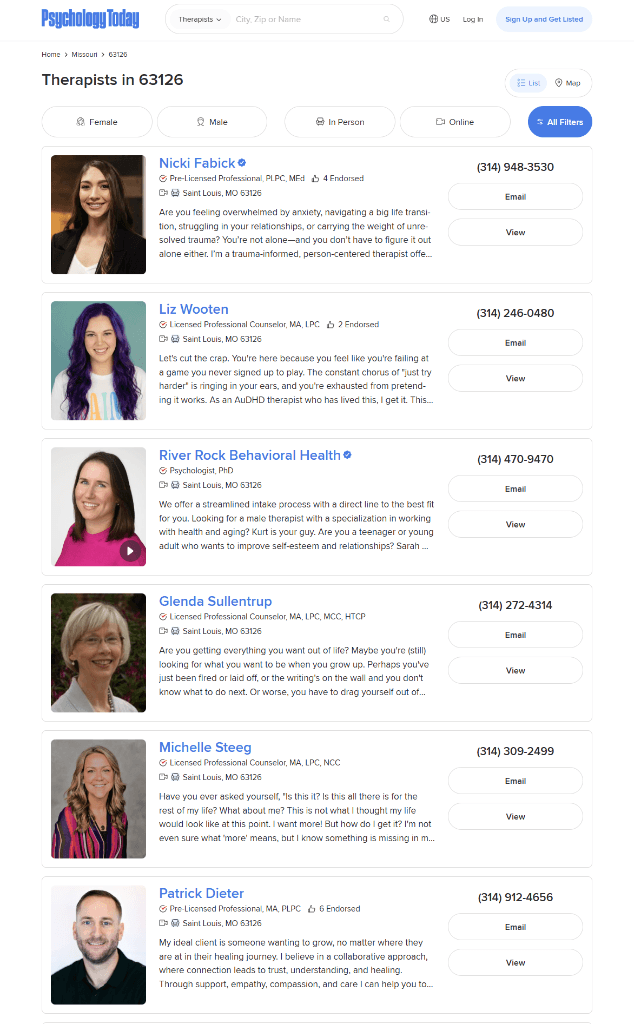
The 270-character preview window is your first point of contact. The person scrolling at 2 AM is looking for someone who speaks directly to their immediate pain. A strong, client-centered hook helps you connect with the people you are best suited to help.
The Anatomy of Your Profile
Here is the part that PT does not make obvious, and that most optimization guides get wrong.
Your personal statement is not one big text box. It is three separate boxes, each with a specific character limit:
Character limits verified June 2026.
Full transparency: our own initial research cited 4,800 characters for the personal statement. That figure appears in older guides across the internet. It is wrong. The verified 2026 structure is 3 boxes totaling 1,360 characters. If a paid “PT optimization guide” still says 4,800, that tells you something — many guides still cite numbers from years ago.
The most important number is not 1,360. It is 270. That is approximately how many characters show as your preview snippet in PT’s search results. This is the entirety of what a potential client sees before deciding whether to click your profile or scroll past you. Everything else is behind the click.
You have 270 characters to convince someone to click on you instead of the 47 other therapists on their screen. That is fewer characters than this paragraph.
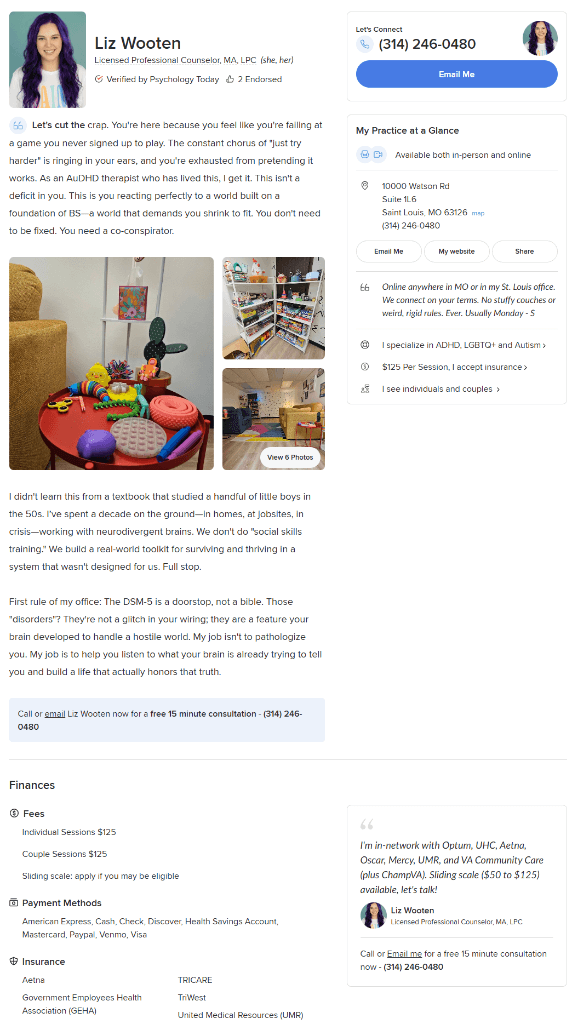
Most therapists treat this as one big text box. It is not. Each box maps to a stage of the conversion funnel: name the pain → build trust → reduce friction.
The 3-Box Funnel
The 3-box structure maps perfectly onto a conversion funnel. Whether PT designed it this way intentionally or not, the three boxes match the three stages of every successful sales conversation: name the problem, build trust, reduce friction.
Box 1: Pain (640 characters — your Hook)
This is your 270-character preview window. Your Box 1 has one job: name the specific pain that your ideal client is experiencing, in the language they would use to describe it.
Not: “I am a Licensed Professional Counselor specializing in anxiety, depression, and life transitions.”
Instead: “You have spent your entire life being told you are ‘so smart’ and ‘so capable’ while quietly drowning. The gap between what everyone sees and what you actually feel is getting wider. I specialize in helping high-functioning adults who are exhausted from performing competence while falling apart underneath.”
The first version tells the reader who you are. The second version tells the reader you understand who they are. One of these makes people stop scrolling.
Box 2: Process (360 characters — your Credibility)
Once they click, they want to know: what does therapy with you actually look like? This is not where you list modalities. This is where you describe the experience.
“We use a mix of talk therapy and body-based work. Some sessions are structured with specific exercises. Some are space to process what happened that week. I am direct — I will not waste your time with platitudes. But I will also not push you faster than your nervous system can handle.”
Notice: no acronyms. No modality names. No theoretical frameworks. Just what it feels like to sit across from you.
Box 3: Invitation (360 characters — your Call to Action)
The person who reads Box 3 is seriously considering contacting you. Your job is to make the first step feel as small and specific as possible.
“If you are thinking about reaching out: the first session is a conversation, not an interrogation. We talk about what brought you here and whether we are a good fit. No commitment beyond that. You can message me through PT, email me directly, or call. I typically respond within 24 hours.”
Every barrier between “I am interested” and “I sent a message” costs you clients. “Reach out today” is vague. “Message me through PT — I respond within 24 hours” is specific.
For the full walkthrough on writing each section with fill-in templates for anxiety, couples, trauma, ADHD, and more, read the companion article: How to Write Your PT Personal Statement: The Three-Stage Funnel.
Why 3 Specialties Beat 15
Psychology Today lets you select from a long list of specialties and star up to 3 as your top focus areas. Most therapists check every box that could remotely apply. Anxiety, depression, trauma, PTSD, grief, life transitions, relationship issues, self-esteem, stress management…
Fifteen specialties. Zero differentiation.
Here is the competitive reality in 2026: platform-affiliated profiles (Grow Therapy, Rula, and others) are flooding Psychology Today with managed listings. These listings are generalists by design — they cast the widest possible net. When every platform-managed profile lists the same 12 broad specialties, the entire first page becomes a wall of identical profiles.
Narrowing your specialties feels terrifying. I know. It feels like you are turning away clients. But here is what happened when I went from 12 specialties to 3: my inquiries went up, because the people who clicked on me were specifically looking for what I actually do. Generalists get scrolled past. Specialists get clicked.
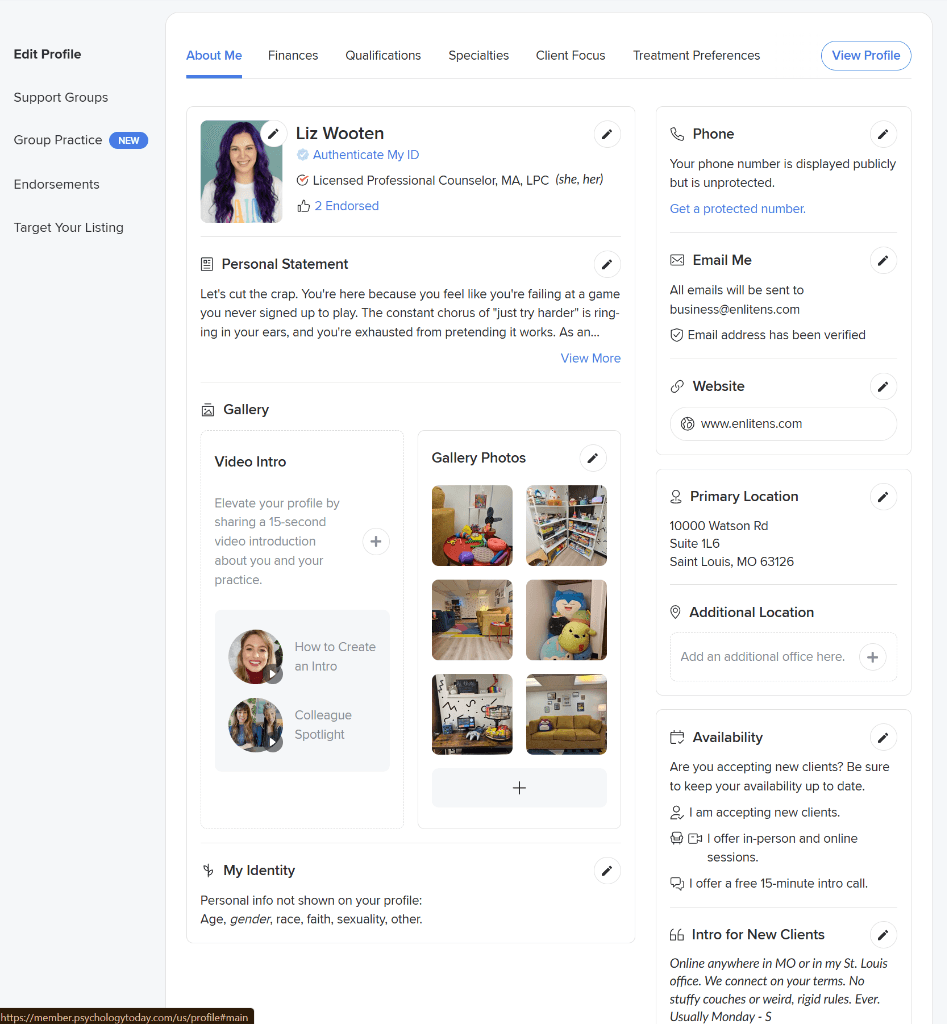
Don't ignore the sidebar fields and gallery! Filling out your video intro, photo gallery, and the 'Intro to New Clients' snippet gives you multiple touchpoints to build trust before a client even clicks 'Email Me'.
The Video Multiplier
PT supports a short video introduction on your profile. Most therapists skip it because they think they need professional equipment. You do not. Your phone can handle it.
There is no published data on exactly how much video improves your inquiry rate. Anyone who gives you a specific percentage is fabricating it. But the three mechanisms above are verifiable — you can test them yourself in PT’s search interface right now.
The sweet spot is roughly 15-25 seconds. Sit near a window for natural light. Look at the camera lens, not the screen. Say: “Hi, I am [name]. I work with [population] who are dealing with [pain]. If that sounds like you, I would love to hear from you.” Done.
If your phone can record a video of your dog doing something stupid, it can record your PT intro.
The 15-Minute Rewrite
Here is your micro-action for this lesson. This is not a marketing project. This is 270 characters. You write longer case notes every single day.
Your first rewrite does not have to be perfect. It has to be better than what is there now. PT does not publish an official “freshness” policy for profile rankings, but industry experts consistently recommend making at least one minor edit per month to signal that your profile is actively maintained. A full strategic rewrite every six months keeps your copy sharp.
No jargon left behind. You are not supposed to know these terms yet. Here is the plain-English decoder for every piece of digital vocabulary used in this lesson, along with its real impact on your practice.
- The 3-Box Funnel
-
Structuring the three separate personal statement boxes in your Psychology Today editor into a simple journey: Box 1 (Pain), Box 2 (Process), Box 3 (Invitation).
SEO Practice Insight:This stops you from treating a crisis-searcher like a board supervisor. Box 1 names the pain; Box 2 details the experience; Box 3 removes schedule friction.
- Preview Snippet (~270-Char Preview)
-
The tiny introductory fragment of your profile statement shown in directory lists before a searcher clicks into your full profile.
SEO Practice Insight:You have roughly 270 characters (as of our last check) to make a connection. If this preview snippet leads with credentials instead of validating pain, searchers scroll past.
Key takeaways
- Your PT personal statement is 3 boxes totaling 1,360 characters. The first ~270 characters are all that show in search results. Lead with the client’s pain, not your credentials.
- The 3-Box Funnel: Box 1 = Pain (name their struggle), Box 2 = Process (what sessions feel like), Box 3 = Invitation (what the first step looks like, specifically).
- 3 starred specialties outperform 15 broad categories. Specificity is your competitive weapon against platform-managed generalist profiles.
- A 25-second phone video unlocks filter inclusion, visual differentiation, and trust signaling. No professional equipment required.