What Does SEO Actually Involve?
What you'll learn
- Explain how Google finds, processes, and ranks web pages (in plain English)
- Name the 4 components of SEO and rate each one's difficulty for DIY
- Identify which SEO activities cost $0 and which might justify hiring someone
- Recognize the 5 red flags of a bad SEO provider
If you are pre-licensed or in your first year of practice: Everything in this course applies to you. You do not need an established practice to start. In fact, starting now gives you a compounding advantage — by the time your caseload pressure arrives, your online presence will already be working. Each module walks you through setup from scratch.
Too busy to read? View the 90-Second Version
SEO is four things, not one. Agencies bundle them to make it seem complex.
- Technical — Site speed, mobile, schema. Mostly a one-time fix.
- On-Page — Your page titles, headings, service copy. Free. Do it yourself.
- Local — Google Business Profile, directories, reviews. Free. Highest return for solo therapists.
- Off-Page — Backlinks, authority. Hardest. The one thing that might justify hiring someone.
Google only does three things: crawl your site, index it, and rank it. If an agency can't tell you which step they're improving — that's a red flag.
SEO Is Not One Thing
SEO. Three letters that have probably cost therapists more wasted money than any other acronym in marketing.
And yet most therapists I talk to — even the ones paying $800 a month for it — still can't explain what they're actually buying. That's not an accident. The less you understand, the more dependent you are on whoever you're paying.
SEO is not one thing. It's four separate things. Agencies bundle them together to make the work seem like one complex, inscrutable package. It's not.
Two of those four things are easy. You can do them yourself, today, for free. The other two are harder — and one of them is where professional help might genuinely make sense.
Let me show you which is which. But first, you need to understand the machine.
How Google Actually Works (3 Steps)
Before you can make smart decisions about SEO, you need to understand what Google is actually doing when someone searches "AuDHD therapist in St. Louis." It's three steps.
Crawl
Google sends software called Googlebot to read websites. Think of it like a librarian walking through every shelf in a massive library, taking notes on every book. If the librarian can't find your book — because nothing points to it, because it's hidden in a back room, or because the door is locked — your book doesn't exist in the library's world. Same thing with your website. If Googlebot can't reach your pages, Google doesn't know you exist.
Index
After reading your pages, Google stores what it found in a giant catalog — the index. Only indexed pages can show up in search results. If your page is crawled but not indexed (this happens more than you'd think), it's like a book the library owns but never put on the shelf. Nobody can find it.
Rank
When someone types "therapist near me," Google sorts through every indexed page that could be relevant and decides the order. This uses hundreds of signals — your content, your credentials, how complete and active your profiles are, whether other reputable sites link to you, and whether previous visitors found your page helpful.
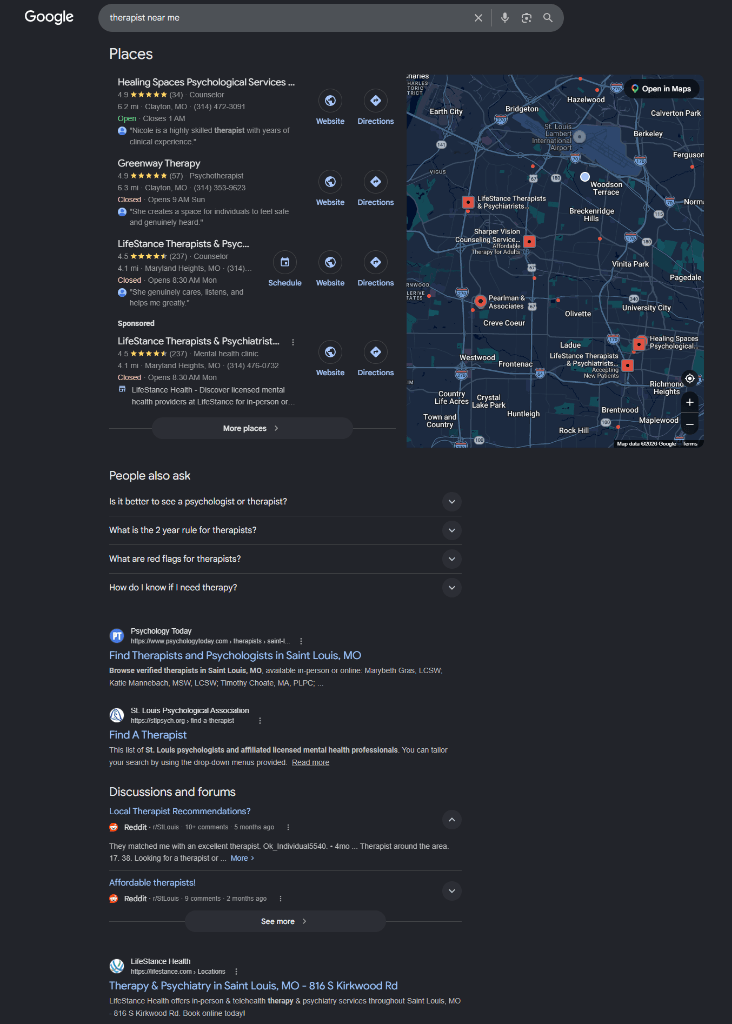
Each of the three Map Pack slots is real estate you can claim for free — through your Google Business Profile. We'll set yours up in Module 2. The organic blue links below are controlled by what's on your actual website — we cover that in Module 3. People Also Ask boxes are filled by Google pulling clear question-and-answer passages from indexed pages, so well-written FAQ-style content can help you appear there. Discussions sections pull from Reddit and forums — your reputation matters everywhere.
That's it. Every SEO activity you'll ever hear about maps back to one of these three steps. Technical SEO helps with crawling. On-page content helps with indexing and ranking. Local SEO and backlinks help with ranking.
The diagnostic question: When someone pitches you an SEO service, you should be able to ask: "Which of these three steps does your work affect?" If they can't answer clearly, that's a red flag.
The 4 Components (With DIY Ratings)
Now that you know how the machine works, here are the four things people mean when they say "SEO." Each one has a different difficulty level and a different cost.
If you're on Squarespace, Wix, or WordPress with a decent host, most of this is handled automatically. Run your site through Google's PageSpeed Insights (free, takes 2 minutes), and test on your actual phone. If both look reasonable, your technical SEO is probably fine.
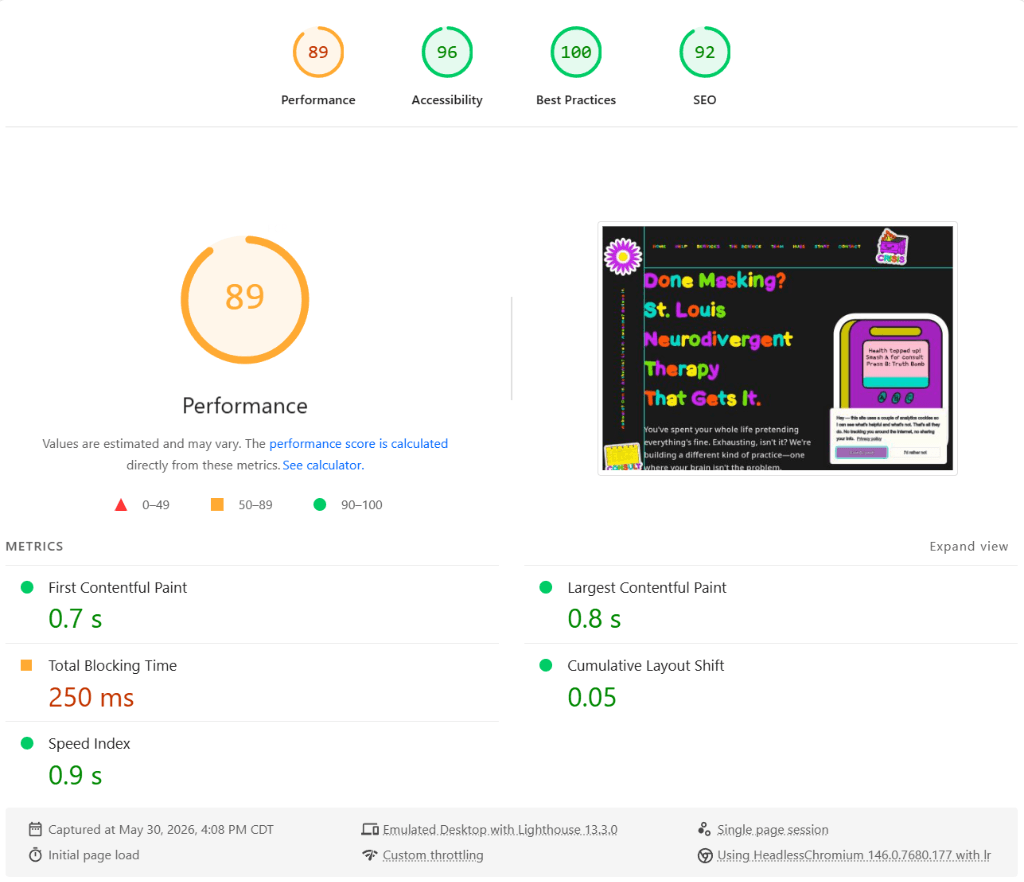
Run this yourself at pagespeed.web.dev — paste your website URL and hit Analyze. If your score is 80+ on mobile, you're fine. Under 50 means something is seriously wrong (usually huge uncompressed images or a slow host). This is a one-time check, not something you need to monitor monthly.
When to pay someone: Only if your PageSpeed score is terrible or pages aren't appearing in Google. A one-time technical audit ($500-$1,500 for a small site) is usually enough. You don't need monthly technical SEO unless your site is large or complex.
5 Red Flags of a Bad SEO Provider
You now know enough to spot trouble. Here are the specific warning signs:
Ask: "Does your work affect crawling, indexing, or ranking?" If they can't answer clearly — or if they answer with jargon instead of specifics — they're hiding behind complexity.
"500 quality backlinks" is not a real service. It's a recipe for a Google penalty. Legitimate link-building for therapists means specific, relevant sites — local news, healthcare directories, professional associations. If they can't name the sites, walk away.
Monthly reports should show specific changes — pages edited, content published, technical fixes applied. If all you get is a dashboard of graphs with no explanation of what actions produced them, you're paying for a screensaver.
Six or twelve months of "SEO work" with no defined milestones is a red flag. Ethical providers can tell you what they'll deliver in month one, month three, and month six — and what results you should expect at each stage.
No one can guarantee you'll rank #1. Google's algorithm uses hundreds of signals, and no outside provider controls all of them. A provider who promises specific rankings is either lying or using tactics that will eventually get your site penalized.
If you see two or more of these red flags, save your money.
What to Do First
If you're starting from scratch, here's the order. Each step builds on the previous:
Steps 1-5 cover 80% of what most therapy practices need. The cost for all five is $0.
If you read that list and realized you've been paying someone $800 a month to do work you could have started yourself — that's useful information.
No jargon left behind. You are not supposed to know these terms yet. Here is the plain-English decoder for every piece of digital vocabulary used in this lesson, along with its real impact on your practice.
- SEO (Search Engine Optimization)
-
Making your website easy for Google to read so it naturally shows your practice to local people who are actively searching for a therapist.
SEO Practice Insight:Unlike paid ads, which stop bringing in clients the second you stop paying, organic SEO keeps bringing in clients with minimal ongoing cost — as long as you maintain it.
- Organic Traffic (Organic Search)
-
Local clients who find your website naturally through a regular Google search results page, rather than clicking a paid advertisement.
SEO Practice Insight:Organic traffic represents the highest-fit clients because they actively sought out answers to their specific struggles rather than being passively marketed to.
- Algorithm
-
Google's automated ranking formulas that scan millions of websites to match a searcher's questions with the most helpful, trusted answer.
SEO Practice Insight:Google's search algorithm is not actively hiding your practice. It simply rewards structured formatting, local proximity, and clear, client-centered specialty pages.
- SERP (Search Engine Results Page)
-
The page of local maps, professional listings, and website links that displays immediately after you search for a term on Google.
SEO Practice Insight:Your goal is to occupy multiple spots on the SERP: one in the Map Pack, one in the directories, and one in organic search links.
- Domain (Website Domain)
-
Your practice's custom address on the internet (for example, `enlitens.com` or `lizwootenlpc.com`).
SEO Practice Insight:Your domain name is an asset. Registering it under your own name (and retaining ownership) is the most critical digital security boundary you can set.
Key takeaways
- SEO is 4 things, not 1. Technical, On-Page, Local, and Off-Page. Two are easy to DIY.
- Understand the machine first. Google crawls, indexes, and ranks. Every SEO activity maps to one of those three steps.
- Start with GBP and on-page content. Free, easy, and covers most of what a solo therapist needs.
- If you're hiring someone, know what you're buying. Ask which step their work affects. No clear answer = red flag.