Where Your Clients Are Looking (And Where They're Not)
What you'll learn
- Name the top 5 channels clients say they'd use to find therapists — with percentages
- Explain why the #1 referral channel costs $0 and requires zero technology
- Describe the 5-level filter clients use to choose a therapist from dozens of options
- Identify 2-3 priority actions for your specific career stage
Too busy to read? View the 90-Second Version
In a 2025 Thriveworks survey, 39% of therapy-seekers said they'd turn to a doctor first — not a Google search. Where clients say they look:
- PCP/Doctor referrals — 39% say they'd start here. The biggest channel, yet most SEO courses ignore it.
- Word of mouth — 32% say they'd ask someone they trust. Real, but you can't control it.
- Google Search + Maps — 28% say they'd search online. The Map Pack matters more than page-one organic.
- Directories (PT, etc.) — 26% say they'd browse a directory. Your profile is a conversion tool, not a résumé.
When clients do search, they run a 5-level filter: Logistics → Pattern Recognition → Identification → Website Review → Contact. Most options get eliminated at Logistics — wrong insurance, wrong location — before a single word gets read.
Where Clients Actually Start Looking
Here's something no marketing course and no SEO agency will ever put on their sales page:
The channel most people say they'd use to find a therapist isn't Google. It's not your website. It's not Instagram. It's their doctor.
| Channel | % who'd use it |
|---|---|
| Primary care provider referral | 39% |
| Word of mouth (friends, family) | 32% |
| Insurance company resources | 31% |
| Search engines (Google, Bing) | 28% |
| Online directories (Psychology Today, etc.) | 26% |
| Health websites (WebMD, ZocDoc) | 25% |
| Social media ads | 21% |
| Therapist social media accounts | 18% |
Source: Thriveworks, November 2025 — survey of 2,000+ U.S. adults who were in, recently in, or considering therapy. Respondents could choose more than one source, so the numbers don't add up to 100%.
One honest caveat: this is what people say they'd use, not a running tally of how every client actually found their therapist — and most folks pick several sources, which is why the numbers overlap. Ask therapists how clients actually reach them and word of mouth often lands at the very top. But notice what holds in every version of this data: the human channels — a doctor, a friend, a colleague — beat the search bar. That's where your attention belongs.
No SEO course teaches this, because there's nothing to sell around "go introduce yourself to the family medicine practice down the street." No software. No subscription. Just a conversation and a stack of business cards.
The Midnight Search
Now let's talk about the 28% who DO find you through Google — because understanding HOW they search changes everything.
Most therapy searches don't happen at 2 PM on a Tuesday while someone's calmly browsing options.
They happen late at night. On a phone. In bed. By someone who almost didn't search at all. They opened the browser, then closed it. Typed the first few letters, then deleted them. Maybe three or four times over a week before the discomfort finally won.
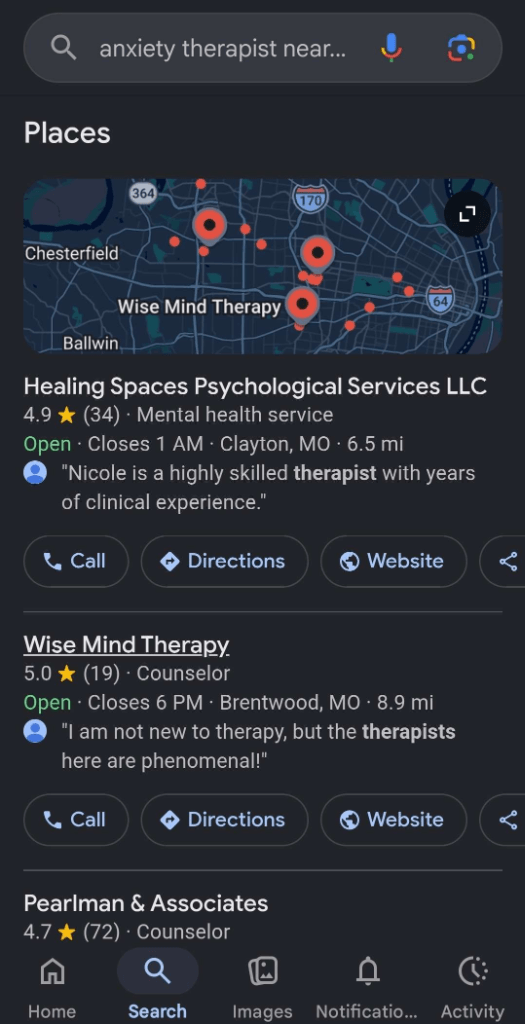
Notice the photo, stars, and 'Open now' badge are the only things visible before tapping. Your Google Business Profile controls ALL of this. We set it up in Module 2.
They're not comparison shopping. They're not reading 15 websites. They'll search for 5 to 20 minutes, scan maybe a dozen profiles, and contact a small handful at most.
Your online presence doesn't need to be perfect. It needs to be clear, human, and fast to evaluate. The person searching at 11:47 PM needs to know three things in under 30 seconds: Do you treat what I'm dealing with? Are you near me? Do you feel like a real person?
The 5-Level Filter
Here's how a potential client goes from 50 options to the one therapist they actually contact.
Logistics — eliminates most options instantly
Location, insurance, availability. If you're too far, don't take their insurance, or aren't accepting new clients, you're eliminated before they read a single word about you.
Pattern Recognition — thins the list again
First impressions of faces form in well under a second (Willis & Todorov, 2006) — and your profile photo gets the same treatment. The client scans your photo, headline, specialty tags. Their brain asks: "Does this look like someone who could help me?"
Identification — the decisive filter
They're reading your actual words. Not evaluating credentials — asking: "Does this person get me?" Clinical language kills you here. "I work with people who are exhausted from trying to hold everything together" beats "I utilize evidence-based modalities" every time.
Website Review (finalists only)
Only 2-3 therapists make it here. 30-90 seconds scanning your about page, services, maybe fees. Looking for confirmation that the profile person is real.
Contact
They reach out to 1-3 people. The one whose website felt the most human usually wins.
If this feels overwhelming, remember: survive the first 3 filters. Accurate logistics, a decent photo, and words that sound like a person — not a textbook. Everything else is refinement.
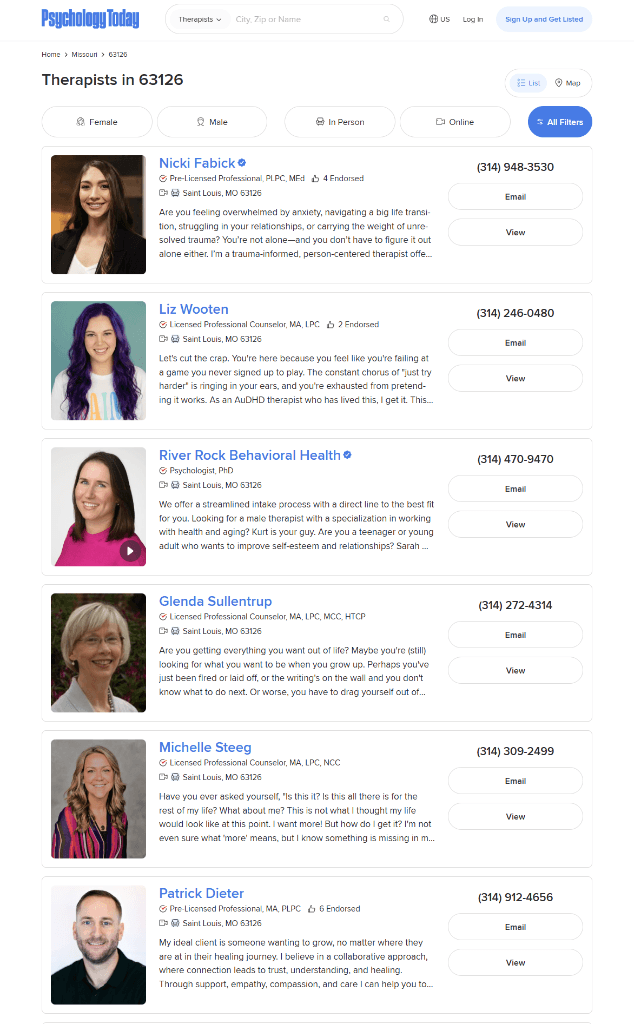
Most therapists write the same generic headline: 'Providing a safe space for healing.' The ones who get clicks are specific: 'EMDR for trauma survivors who are tired of just talking about it.' We cover how to write these in Module 4.
What to Do Based on Where You Are
Not everything matters equally at every stage. Expand the section that matches where you are right now:
No jargon left behind. You are not supposed to know these terms yet. Here is the plain-English decoder for every piece of digital vocabulary used in this lesson, along with its real impact on your practice.
- Search Intent
-
The specific reason or mental state behind a user's search—whether they want to learn something, compare options, or schedule a session immediately.
SEO Practice Insight:Mapping your website pages to search intent prevents you from treating a client in crisis like a shopper. Niche blog posts answer learning questions; your home page handles scheduling.
- Discovery Channels
-
The distinct pathways clients travel to find and contact your practice (e.g., local maps, directory profiles, peer referrals, or search engine results).
SEO Practice Insight:Auditing which discovery channel brings in your best-fit clients tells you exactly where to spend your 2-3 hours of monthly marketing time.
- Local Map Pack (Map Pack)
-
The map graphic and list of three local business profiles that Google displays prominently at the very top of local search results.
SEO Practice Insight:For therapists, the Map Pack is one of the highest-converting channels for local-intent searches.
Key takeaways
- Your referral network is one of your most powerful channels — 39% of therapy-seekers say they'd turn to a doctor, and it costs $0. Start there.
- Google searches happen in pain, not in calm. Design your online presence for someone at 11:47 PM who needs to decide in 5 minutes.
- Survive the first 3 filters. Accurate logistics, a good photo, and words that sound human.
- Match your actions to your career stage. Do the 2-3 things that matter most for where you are right now.